In June 2026, Singapore's Ministry of Health revoked the licence of Windsor Convalescent Home after a routine audit found systemic neglect — expired medication, untreated pressure injuries, and a failure of basic care. A regulator caught it, stepped in, and moved the residents to safety.
Malaysia regulates elder care differently. JKM registers and inspects care centres and MOH licenses clinical nursing homes, but oversight leans on registration and follow-up after concerns are raised, rather than the routine audits of every home that Singapore runs. A more comprehensive law — Act 802 (2018) — has been passed and is awaiting full implementation.
The practical takeaway: in Malaysia, as in most countries, an engaged family is one of the strongest safeguards. This guide explains what to check, and why it matters.
On this page
What Happened at Windsor
Windsor Convalescent Home was a 45-bed private nursing home in Pasir Panjang, Singapore. In April 2026, a routine audit by Singapore's Ministry of Health (MOH) found "serious and systemic lapses" in resident safety, clinical care, and infection control.
The specifics were the kind families fear most: medications omitted or past expiry; falls, pressure injuries (bedsores) and weight loss never properly reviewed; care plans ignored; basic grooming and nutrition neglected. MOH blamed "a lack of control, governance and oversight by the home's key office holders."
On 18 June 2026, MOH moved to revoke the licence — but didn't just close the doors. It deployed an interim care team to take over immediately, and the Agency for Integrated Care helped transfer residents to other homes.
References: Ministry of Health Singapore statement — moh.gov.sg
The detail that matters most isn't the neglect — it's how it was caught. No complaint, no viral video: a government auditor found the problems during a standing audit programme, and the regulator could step in and arrange new care. Malaysia's system works differently, which is why a family's own checks carry extra weight.
How Malaysia's System Works Differently
Malaysia regulates residential elder care through a framework shared across two authorities:
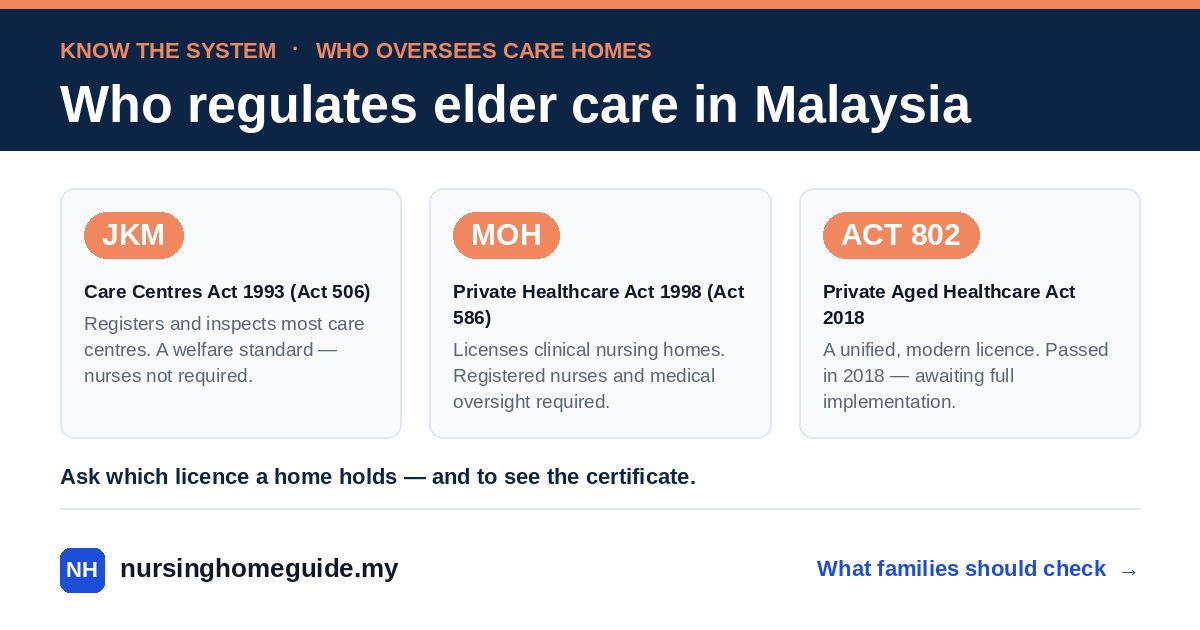
JKM — Care Centres Act 1993 (Act 506): The Department of Social Welfare registers and inspects "care centres" (pusat jagaan). This is the welfare-level standard that covers the large majority of elder-care homes. It does not require nurses on staff.
MOH — Private Healthcare Facilities and Services Act 1998 (Act 586): The Ministry of Health licenses the smaller number of true clinical nursing homes with registered nurses and medical oversight.
Act 802 — Private Aged Healthcare Facilities and Services Act 2018: The comprehensive law meant to bring all aged-care facilities under one modern licensing regime. It was gazetted in 2018 — but as of 2026 it has still not been brought into force, because its subsidiary regulations were never finalised.
In practice, oversight focuses on registering and inspecting homes at the licensing stage, then following up when concerns are raised — rather than continuously auditing every home. JKM registers, inspects, and takes enforcement action, but day-to-day visibility often depends on families, staff, and the public flagging problems early. See our JKM vs MOH licensing guide for the full breakdown.
Scale is part of the challenge. A parliamentary answer reported in April 2024 put 1,028 unregistered care centres under JKM monitoring (elderly and disability centres combined), with action taken on most — including 465 that ceased operations. Homes outside the net are harder to count; estimates run from several hundred to as many as 2,000. Enforcement is active, but has a lot of ground to cover.
References: Care Centres Act 1993 (Act 506) — commonlii.org · JKM unregistered-centre figures (parliamentary answer, reported Apr 2024) — majoriti.com.my · Act 802 enforcement status — CodeBlue
Malaysia Has Had Its Own Cases
Malaysia hasn't had a single regulator-led revocation quite like Windsor, but it has had serious documented incidents — and they tend to surface the hard way: a viral video, a fire, or a whistleblower.
Alleged systemic abuse at an old folks' home
After a video of a caretaker taunting a resident went viral, four former employees alleged years of routine abuse — residents hit, starved, and over-sedated. Welfare authorities investigated and the home was reported ordered to close. It came to light only because former staff spoke up.
Caregiver filmed beating a resident; home was unregistered
Video showed a caregiver striking an elderly man with a stick. Police arrested the operator and a helper, and a staff member was fined after pleading guilty. The minister confirmed the home was not registered with JKM. Months later, 21 residents linked to the same operation were found abandoned and re-homed by the welfare department.
Five dead in a fire at an unlicensed home
A pre-dawn fire killed four residents and a caretaker. The state welfare department confirmed the home ran without a business licence or the permit required under the Care Centres Act 1993. It is the deadliest documented Malaysian care-home incident — and shows why registration, which includes a fire-safety check, is not a formality.
A 2023 fire at an old folks' home in Section 5, Petaling Jaya killed one resident — neighbours had been asking the council to check the home's licence since 2022.
The Common Thread
Across those cases, one fact stands out: nearly every serious incident involved a home that wasn't properly registered. Unregistered doesn't automatically mean unsafe, but it sits outside the system — no premises inspection, no fire-safety sign-off, no vetting of the operator. Registration is the line authorities enforce, and the one families can check for themselves.
So the most useful step is also within your control: choose a registered home, visit before you commit, and keep visiting afterwards.
How to Protect Your Parent
You can't run a clinical audit, but the things you can do line up with what the Windsor audit checked: registration, basic care, and ongoing oversight.
- Confirm registration before you commit. Ask to see the JKM certificate (Sijil Pendaftaran Pusat Jagaan), check it hasn't expired, and ask which Act the home is licensed under. Our how-to-verify guide walks through it.
- Visit unannounced, and use your senses. Smell, skin condition, staffing at a quiet hour, and whether residents are clean and engaged tell you more than any brochure. Our warning-signs guide lists what should make you walk away.
- Ask about the things Windsor failed on. How are medications stored and recorded? Who reviews falls, bedsores and weight loss? Is a registered nurse on duty overnight?
- Keep visiting at varied times. Every case above stayed hidden until someone looked. Regular, unpredictable visits are the most effective deterrent to neglect.
- Know how to escalate. Report concerns to the local JKM district office (Pejabat Kebajikan Masyarakat Daerah), and the police if a resident has been harmed.
Registration is the floor, not the ceiling. A JKM certificate means a home cleared a minimum bar at inspection — not that care is good today. Treat it as necessary but not sufficient, and let what you see on your visits be the deciding evidence.
Frequently Asked Questions
Before you choose a home
Verify the licence, learn the warning signs, and walk a tour with the right questions in hand.
Verify a JKM Licence → Warning Signs → How to Choose →This guide is general information for Malaysian families, not legal advice. Case details are drawn from public news reports and official statements; where an allegation has not been tested in court, we have described it as alleged. NursingHomeGuide.my is an independent directory and is not affiliated with any facility mentioned.