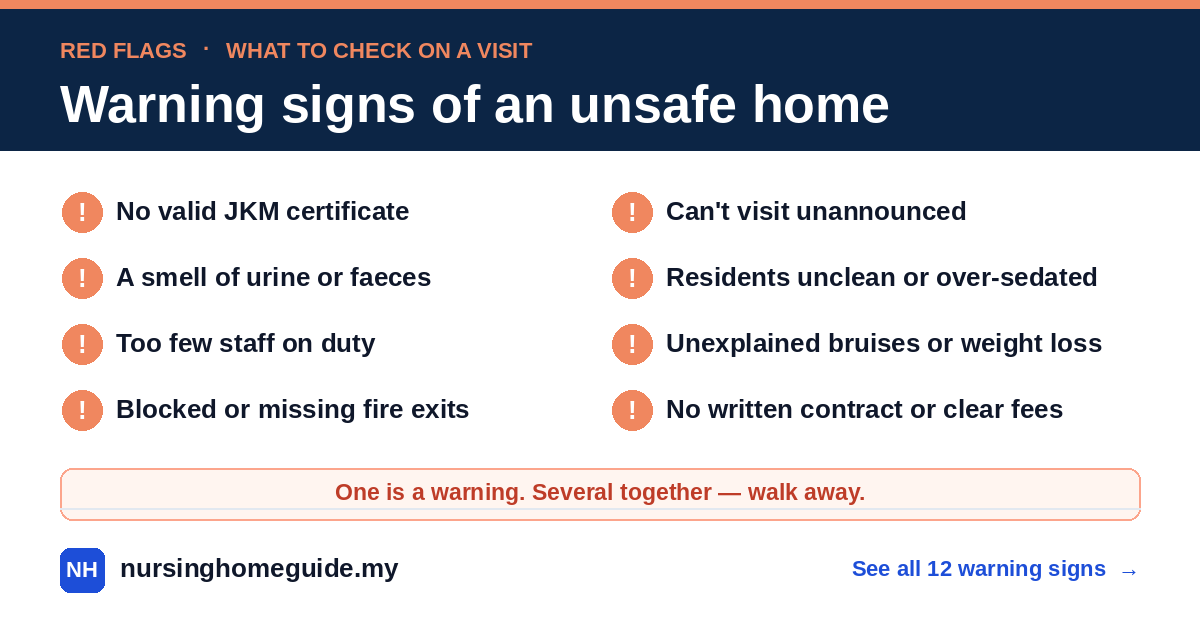
The clearest red flags: no valid JKM certificate, a smell of urine or faeces, too few staff, residents who are unclean or over-sedated, no clear fire exits, and reluctance to allow unannounced visits.
On your relative, watch for unexplained weight loss, pressure sores, bruises, dehydration, and sudden fear or withdrawal.
One red flag means ask hard questions. Several together mean walk away.
On this page
Why This Matters in Malaysia
Some countries publish a public quality score for every nursing home. Malaysia does not — its oversight works differently, leaning on registration with JKM and MOH and on following up when concerns are raised, rather than a continuous audit of every home. For the full picture, see our guide on nursing home safety and how the system works.
So the person most likely to catch a problem early is often you. Almost every serious Malaysian care-home case in recent years — abuse in Seremban, a beating in Kedah, a fatal fire in Kajang — came to light because a family member, former employee, or neighbour noticed something and spoke up. The signs below are what they noticed.
Warning Signs You Can Spot on a Visit
Visit in person, and ideally visit twice — once on a scheduled tour, once unannounced at a quiet hour. Use all your senses.
-
A persistent smell of urine, faeces or heavy air freshener
A brief odour happens anywhere. A pervasive smell — or heavy perfume masking one — usually means residents aren't being changed often enough, and ventilation is poor.
-
Too few staff for the number of residents
Count staff against residents at a quiet hour. If a few workers cover dozens of dependent residents, individual care isn't possible. Ask the ratio on day and night shifts.
-
Residents who are unclean, dehydrated, or left alone for long stretches
Look at the residents, not just the lobby. Soiled clothing, untrimmed nails, dry lips, empty water cups, and people left in front of a TV with no engagement all signal under-staffing.
-
No clear fire exits, extinguishers, or evacuation plan
Blocked exits, missing or expired extinguishers, and staff who can't explain how they'd evacuate bed-bound residents are a life-safety red flag. Fatal Malaysian care-home fires happened in exactly these conditions.
-
Crowding, poor ventilation, or unsafe premises
Beds packed together, no airflow or natural light, slippery floors, and no bathroom grab rails point to a premises never set up — or inspected — for safe care.
-
You're not allowed to see the bedrooms or visit unannounced
A home with nothing to hide shows you where residents actually live and sleep, and won't object to you dropping in. Confining visitors to a tidy reception, or insisting all visits be scheduled, is a serious red flag.
-
Residents seem fearful, silent, or discouraged from talking to you
If residents avoid eye contact, fall quiet when staff are near, or are steered away from visitors, take it seriously. In documented abuse cases, residents had been intimidated into silence.
Warning Signs in Your Relative After Admission
Neglect is the most common form of elder abuse in Malaysia, and it often shows on the person before any home admits it. Between visits, watch for:
-
Unexplained weight loss or signs of dehydration
Clothes suddenly loose, sunken eyes, dry mouth. Failure to provide adequate nutrition and fluids is among the most common — and most dangerous — forms of neglect.
-
Pressure sores (bedsores) or poor personal hygiene
Bedsores develop when a resident is left in one position too long. With unwashed hair, dirty nails and soiled clothing, they signal that basic daily care isn't happening.
-
Unexplained bruises, injuries, or a vague story about how they happened
Bruises, cuts or fractures that staff can't clearly explain — or explain only as "a fall" — warrant questions and, if serious, a report. Ask to see the incident record.
-
Sudden withdrawal, fearfulness, or unusual drowsiness
A parent who becomes frightened, stops talking, or is consistently over-drowsy may be reacting to mistreatment — or being over-sedated to be easier to manage. Both are worth pursuing.
-
The home resists questions, blocks access, or changes the story
Defensiveness when you ask about medication, meals or an injury — or shifting explanations — is itself a signal. A home providing good care can answer plainly and show you records.
Paperwork & Operator Red Flags
Some of the most important warning signs are on paper, not on the tour:
- ⚠ No JKM registration certificate, or an expired one, or staff who can't produce the registration number. This is the single most important red flag — verify it before anything else (how to verify).
- ⚠ No written contract, no clear fee breakdown, or pressure to pay large sums in cash upfront.
- ⚠ No named person in charge, or no registered nurse on staff at a home that markets itself as providing nursing care.
- ⚠ No clear policy for medication, medical emergencies, or which hospital residents are sent to.
When to Walk Away
- The home cannot show a valid, unexpired JKM registration certificate
- There is a persistent smell of urine or faeces throughout the premises
- You are refused entry to the bedrooms or told you cannot visit unannounced
- Fire exits are blocked or there is no visible fire-safety equipment
- Staffing is clearly far too thin for the number of dependent residents
- Residents appear frightened, over-sedated, neglected, or are steered away from you
No home is perfect, and minor issues can be raised and fixed. But the items above aren't minor — if you see them, assume what's visible reflects what isn't, and a registered alternative is worth the extra search.
What to Do If You See Warning Signs
If your relative is already in a home and you're worried:
- 1 Document it. Note dates, take photos of injuries or conditions, and keep a simple record of what you observe on each visit.
- 2 Raise it in writing. Put specific concerns to the home and ask for a written response — this creates a record and tests how they handle accountability.
- 3 Report it. Contact the local JKM district office (Pejabat Kebajikan Masyarakat Daerah). If a resident has been physically harmed, lodge a police report as well.
- 4 Move them if needed. If concerns are serious, don't wait for the home to improve — find a registered alternative.
Trust what you see over what you're told. Brochures and a polished tour are marketing. An unannounced visit, the condition of the residents, and the home's willingness to answer plainly are evidence. When they conflict, believe the evidence.
Frequently Asked Questions
Use this alongside
Verify the licence, understand the regulatory gap, and walk a full tour with a complete checklist.
Verify a JKM Licence → How to Choose → Safety & the Law →This guide is general information for Malaysian families, not legal or medical advice. Case references are drawn from public news reports and official statements. NursingHomeGuide.my is an independent directory and is not affiliated with any facility mentioned.